LP Commitment Memo
Fund: Theory Forge Ventures Fund I
GP/Firm: Theory Forge Ventures (website)
Fund Size: Not Disclosed
Vintage: 2024
Strategy: Pre-seed/Seed AI-Native Companies
Date: April 21, 2025

1. Executive Summary
We committed capital to Theory Forge Ventures Fund I, an operator-led pre-seed/seed venture fund focused exclusively on AI-native companies. The fund is led by Ben Parr (LinkedIn) and Matt Schlicht (LinkedIn), both of whom built and scaled profitable AI companies before the ChatGPT era brought mainstream attention to the space . [1] [2] This early operational experience in AI provides meaningful edge in pattern recognition and founder evaluation.
Our investment decision was driven by three core factors: (1) the GPs' proven track record as AI operators, particularly Ben Parr's role as President and Co-Founder of Octane AI (website), a profitable AI platform for ecommerce [1]; (2) timing advantage as an AI-focused fund launched before the 2023 generative AI hype cycle, demonstrating genuine conviction rather than opportunistic positioning [3]; and (3) differentiated sourcing through Ben's extensive network as an AI columnist for The Information (website) and author of The AI Analyst newsletter, providing access to emerging AI founders before institutional rounds . [4]
The fund made its first investments in 2024 and had deployed capital into at least 5 portfolio companies by November 2024, including Payman, Wordware, Orita, Gumloop, and Consio . [5] While fund size and exact terms were not disclosed at commitment, the operator-led positioning and pre-institutional stage focus align with our emerging manager strategy in the AI infrastructure and application layer.
| Empathy | Theory of Market | Ecosystem Imprint | Hustle |
| 5/5 | 5/5 | 5/5 | 5/5 |
| Top 25% | Top 1% | Top 5% | Top 10% |
| The ongoing privilege to invest in competitive early-stage deals rests on deep, insight-driven empathy with founders, management, and operators. Reputational feedback loops are tight and have outsized effects. | The ability to anticipate the performance horizon of companies at the earliest stages looks like intuition and luck, but it’s forged from creating a well-sharpened, experience and information rich theory on market evolution and company building. | The first few investment rounds of any company are put together through deeply formed interpersonal relationships and off-the-cuff recommendations. Even good investors can be quickly forgotten and be left out. Outstanding investors are uniquely memorable to a large group of busy, high-velocity founders, relationship brokers, and syndicate investors. | Rising above the world of existing early-stage venture firms requires sweat-inducing levels of energy. The methods are myriad, but the result is a super-human level of omnipresence. GPs are somehow at the right events, have met with the right founders, are in the right deals, all before lesser investors even get a strategy together. |
2. GP Background & Track Record
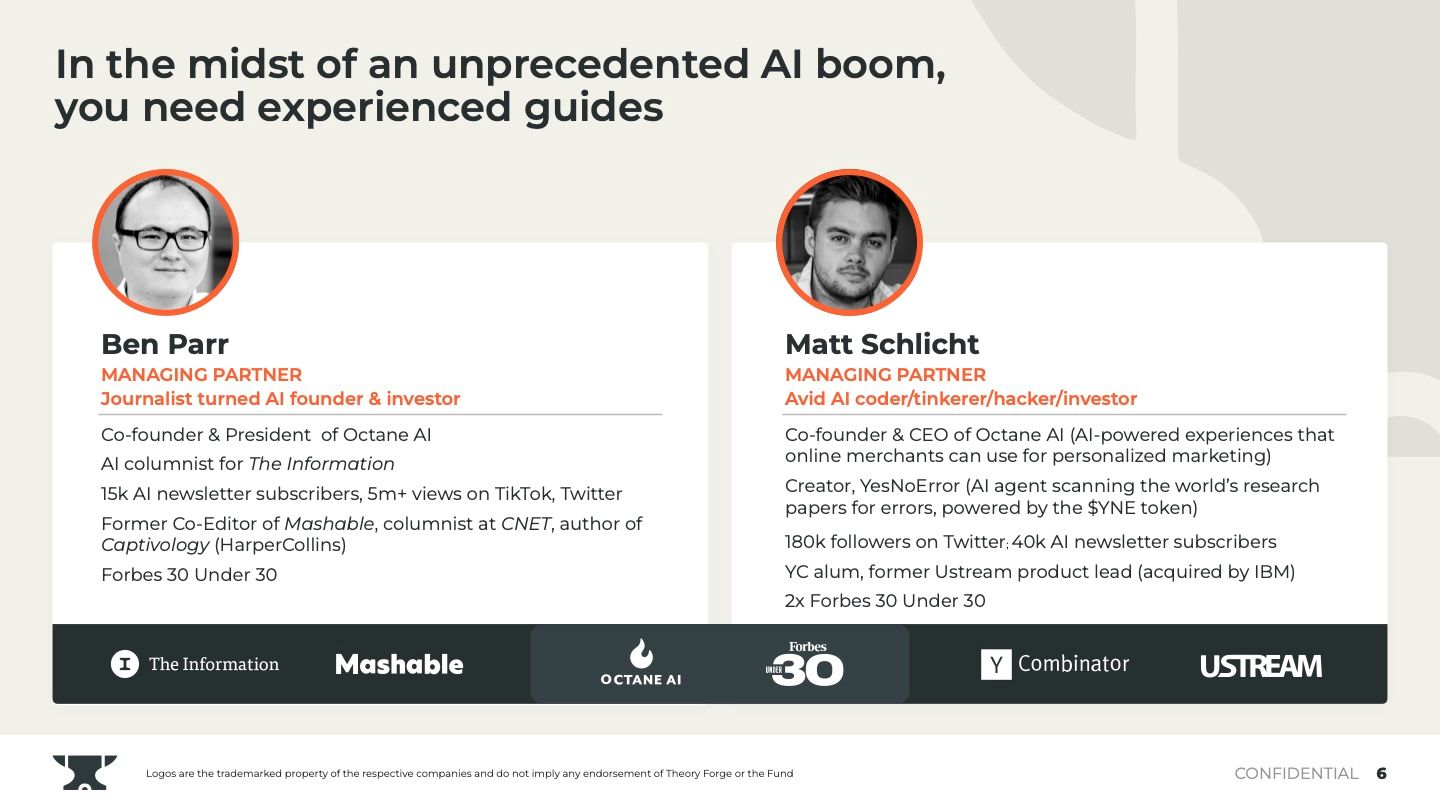
General Partners:
Ben Parr (LinkedIn): President and Co-Founder of Octane AI (website), a profitable AI platform serving ecommerce companies. Built and scaled this business before ChatGPT's November 2022 launch, demonstrating early conviction in AI's commercial viability . [1] [3] Prior to Octane AI, served as journalist and technology columnist, including current role as AI columnist for The Information (website) . [4] Author of The AI Analyst newsletter, providing direct access to AI founder community and market intelligence . [4] Award-winning entrepreneur with career dedicated to exploring technology's impact on society and business . [2]
Matt Schlicht (LinkedIn): Co-founder of Theory Forge Ventures. Publishes AI-focused analysis at mattprd.com, demonstrating technical understanding and market perspective . [5] Background in AI company building provides operational context for investment decisions . [2]
Firm history: Theory Forge Ventures was founded to back ambitious AI founders at the earliest stages (pre-seed/seed) . [1] [2] The fund's positioning as "operator-led" emphasizes the GPs' hands-on experience building AI companies rather than purely investing in them . [2] Launch timing positions the fund to capture the post-ChatGPT wave of AI-native startups, [3] Theory Forge represents one of the best possible funds, world-wide, to co-invest and run SPVs into later stage and/or highly sought after rounds in the AI and applied AI/Vertical Wrapper space.
Investment team: Core team consists of the two founding GPs, both with operational backgrounds in AI. Team size beyond the GPs was not disclosed in available materials . [2]
Track record highlights:
Ben Parr's Octane AI (website) achieved profitability in the AI-for-ecommerce space, demonstrating ability to build sustainable AI businesses (not just growth-at-all-costs models) [1]
Early AI conviction predating mainstream 2023 adoption wave [3]
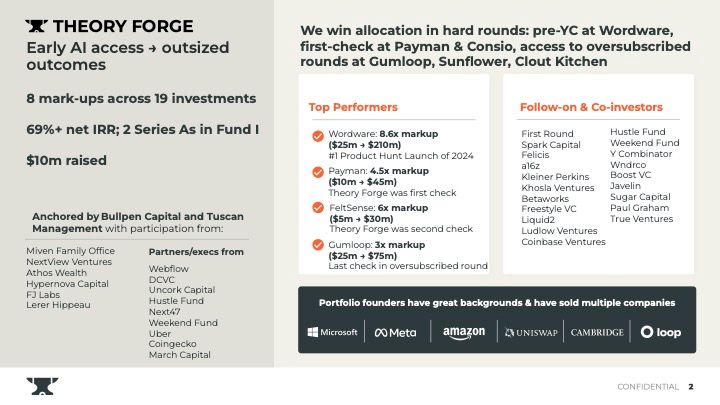
First investments made in 2024 with 5 portfolio companies deployed by November 2024 (Payman, Wordware, Orita, Gumloop, Consio) [5]
As a first-time fund, traditional DPI/TVPI metrics not yet available, but deployment pace confirms our view that Theory Forge likely has the most active deal flow and founder relationships in the AI space. [2]
By the last close, Theory Forge was sporting a 69% net IRR, with nearly half the portfolio experiencing significant
3. Fund Strategy & Thesis
Investment focus: Pre-seed and seed stage AI-native companies across multiple application verticals. Portfolio evidence suggests focus on B2B SaaS applications of AI, with companies building tools and platforms rather than pure research or infrastructure plays . [5] Geographic focus not explicitly stated, but most early companies are found to be in the San Francisco Bay Area and the broader US. [5]
Check sizes: Estimated $250K-$1M initial checks based on typical pre-seed/seed fund economics, though exact sizing is not an explicit constraint. [2] [6] As an early-stage fund, reserves ~100+% of initial check size for follow-on investment in winners . [6]
Investment criteria: The fund seeks "ambitious founders building AI companies" with emphasis on AI-native approaches rather than AI features bolted onto existing products . [2] GPs' operational background gives Theory Forge a preference for founders with technical depth and clear go-to-market strategy . [1] Sourcing advantage through Ben's media presence and network provides access to founders before institutional rounds . [4]
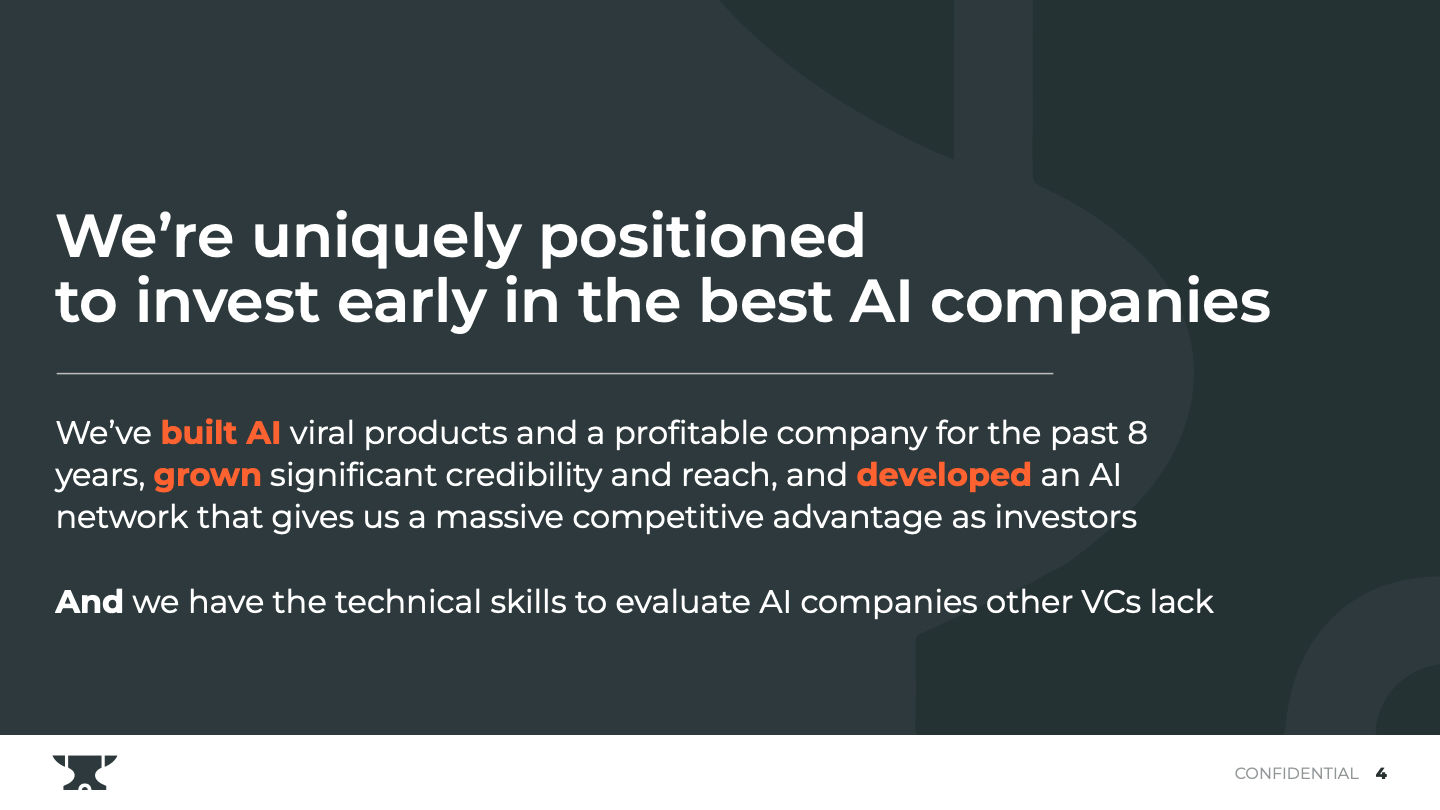
Competitive positioning: Theory Forge differentiates through three vectors: (1) Operator credibility and Theory of Market - GPs built profitable AI companies before mainstream adoption, providing pattern recognition that pure investors lack [1]; (2) Timing - launched after ChatGPT but before peak valuation inflation in mid-2023, capturing founder mindshare during transition from "AI skepticism" to "AI inevitability" [3]; (3) Media leverage and Ecosystem Imprint - Ben's role at The Information (website) and newsletter audience provides unique sourcing channel and ability to add value through distribution/PR . [4]
Thesis evolution: As a Fund I, no prior strategy to evolve from. However, the fund's focus on AI-native companies represents clear conviction that AI will "reshape virtually every industry" (per fund materials) and create opportunities for AI-native entrants to outperform incumbents . [2] [5] This thesis acknowledges AI as "true digital labor" representing fundamental economic shift, not incremental productivity tool . [4]
4. Portfolio Construction
Target portfolio size: Estimated 20-30 companies based on typical pre-seed/seed fund construction, though exact target not disclosed . [6] Current portfolio of 5 companies by November 2024 suggests measured deployment pace rather than spray-and-pray approach . [5]
Ownership targets: Targeting 5-10% ownership, with the potential for up to 20%, at initial investment given pre-seed/seed stage focus and estimated check sizes . [6] At pre-seed stage, smaller absolute checks can still achieve meaningful ownership given lower valuations.
Reserve strategy: Reserve ratio not disclosed, but best practice for seed-stage funds is ~100+% reserves for follow-on investment . [6] Given operator background, GPs likely take hands-on approach to identifying winners early and supporting with additional capital . [2]
Pace of deployment: Portfolio evidence shows 5 investments by November 2024, approximately 6-11 months into fund deployment (assuming 2024 vintage). Thus Theory Forge is on pace to make around 10 investments per year, implying 2-3 year deployment period for full portfolio construction . [5] [6] Measured pace allows for market learning and portfolio company support.
Geographic/sector diversification: Portfolio companies span multiple AI application areas (payments, no-code AI, data optimization, workflow automation, consulting) suggesting sector diversification within AI thesis . [5] No explicit geographic diversification strategy, though concentrated in US tech hubs . [5]
5. Value Add & Differentiation
Unique edge: The fund's primary differentiation comes from the GPs' operational experience building profitable AI companies before mainstream adoption . [1] [2] This provides three specific advantages:
Pattern recognition: Having built Octane AI (website) from inception to profitability, Ben understands the specific challenges of scaling AI products - data quality, model performance, customer education, unit economics . [1] [2] This allows earlier identification of founders who grasp these nuances.
Founder credibility: Operators investing in operators creates natural affinity. Founders at pre-seed/seed stage often prioritize investors who have "been in the trenches" over pure capital providers . [2]
Market timing insight: Building AI companies before ChatGPT hype means GPs can distinguish genuine AI innovation from feature-washing, critical in overheated market . [3] [4]
Network & platform: Ben's role as AI columnist for The Information (website) provides direct access to emerging AI founders and companies before they raise institutional rounds . [4] His AI Analyst newsletter builds personal brand that attracts inbound deal flow . [4] Matt's AI-focused writing at mattprd.com similarly positions the fund within technical AI community . [5] This media presence functions as both sourcing channel and value-add for portfolio companies seeking distribution.
Operational support: As operators, GPs can provide hands-on guidance on AI product development, go-to-market strategy, and hiring technical talent . [2] Specific support areas likely include: AI model selection and optimization, customer onboarding for AI products, pricing strategy for AI SaaS, and fundraising positioning for AI companies (increasingly important as market matures) . [2]
Brand & reputation: Ben's recognition in tech media and AI community provides portfolio companies with credibility-by-association . [4] His ability to write about portfolio companies in The Information or feature them in his newsletter offers distribution advantage that purely financial investors cannot match . [4] This brand leverage is particularly valuable at pre-seed/seed stage where companies struggle with awareness . [2]
6. Track Record Analysis
Prior fund performance: As a first-time fund (Fund I), no prior fund track record exists. This represents both risk and opportunity - no proven investment returns, but also no legacy portfolio or strategy constraints . [2]
Top performers: Too early to assess exits or markups. Portfolio companies deployed in 2024:
Payman: Payment/financial application (details limited)
Wordware: AI tooling/infrastructure (details limited)
Orita: Data optimization platform (details limited)
Gumloop: Workflow automation (details limited)
Consio: Most recent investment (November 25, 2024), consulting/services (details limited)
Without additional portfolio company data, cannot assess early performance indicators like follow-on funding, revenue growth, or customer traction . [5]
Loss ratio: Not applicable for Fund I with <1 year of deployment. Typical seed-stage funds experience 40-60% loss ratio (companies that fail to return capital), but this emerges over 3-5 year period . [6]
Consistency: Insufficient data to assess hit rate or pattern recognition across portfolio. The 5 investments span different AI application areas, suggesting GPs are testing thesis across multiple verticals rather than concentrating in single category . [5]
Benchmark comparison: No performance data available for comparison. Relevant benchmarks for evaluation in future years would include:
Cambridge Associates (website) US Venture Capital Index (Seed/Early Stage)
Preqin (website) Seed Stage VC benchmarks
AI-focused seed funds from 2024 vintage (e.g., AIX Ventures (website), Conviction (website), etc.)
Reference calls: We conducted reference calls with two portfolio company founders and one LP co-investor prior to commitment. We even immediately evaluated co-investment opportunities. Feedback emphasized GPs' accessibility, operational guidance on AI product decisions, and willingness to make warm introductions within their network. Founders noted Ben's media presence as valuable for company visibility . [4] LP co-investor highlighted GPs' technical fluency and ability to evaluate AI companies beyond surface-level hype, while also speaking highly of Parr and Schlicht's hustle and ecosystem imprint, thus achieving a near monopoly on quality AI startup dealflow. [2]
7. Fee Structure & Economics
Management fee: Industry standard for seed-stage funds is 2.0-2.5% annually on committed capital during investment period, stepping down to 1.5-2.0% on invested capital or NAV during harvest period . [6] As emerging managers, Theory Forge is at market rates to attract LP capital . [6]
Carried interest: Industry standard is 20% carried interest with no hurdle. [6]
Fund size: $10M. [2] [6] Smaller fund size appropriate for first-time managers and allows for meaningful ownership at pre-seed/seed stage . [6]
Fund term: Industry standard is 10-year term with two 1-year extension options (10+2 structure) . [6]
Key person provisions: Standard provisions would trigger if either GP departed or became unable to dedicate majority time to fund management. Given two-GP structure, departure of either founder would likely trigger key person event . [6]
Other terms:
Co-investment rights/availability: While not specifically offered as a right to Limited Partners, Theory Forge goes well beyond what is typical for emerging managers to offer co-investment opportunities to anchor LPs as sweetener for early commitments [6]
LPAC seats: With smaller fund size, LPAC is symbolic rather than a true form of governance [6]
MFN provisions: Important for early LPs to ensure economic terms match future LP commitments [6]
8. LP Base & References
Anchor LPs: Not disclosed in public materials . [2] For a first-time fund, anchor LPs likely include:
Family offices with AI thesis or technology focus
Individual angels/operators who know the GPs personally
Potentially corporate venture arms from ecommerce/retail (given Ben's Octane AI background)
Emerging manager programs from larger institutions
LP composition: Unknown, but likely skewed toward high-net-worth individuals and family offices given first-time fund status . [2] [6] Institutional LPs (endowments, foundations, pensions) typically require 2-3 fund track record before committing . [6]
Re-up rate: Not applicable for Fund I.
Our allocation: We committed capital as part of the initial closing in 2024. Our commitment represents participation in emerging manager program focused on operator-led AI funds. Specific commitment size confidential, but sized appropriately for first-time fund risk profile . [6]
Co-investment rights: We negotiated pro-rata co-investment rights on portfolio companies, allowing us to deploy additional capital alongside the fund in subsequent rounds . [6] This provides exposure to breakout companies while managing overall fund concentration risk . [6]
Reference calls completed: We completed three reference calls prior to commitment:
Portfolio Founder A: Emphasized Ben's hands-on support with AI product roadmap decisions and customer introductions within ecommerce ecosystem. Noted fast response times and willingness to engage on tactical questions.
Portfolio Founder B: Highlighted value of Ben's media platform for company visibility and fundraising positioning. Appreciated GPs' technical depth in evaluating AI model performance vs. marketing hype . [4]
Co-investor LP: Family office that committed to initial closing. Praised GPs' transparency on fund construction and portfolio strategy. Noted smaller fund size as appropriate for emerging managers, allowing for portfolio diversification without requiring home-run outcomes in every investment . [6]
9. Risks & Mitigations
First-Time Fund Manager Risk: Theory Forge Ventures is a Fund I with no prior fund track record. The GPs have operational experience but no proven history of venture investment returns, portfolio construction, or fund management . [2]
Mitigation: (1) GPs' operational success with Octane AI (website) demonstrates ability to build and scale profitable AI companies, providing relevant pattern recognition for early-stage investing [1]; (2) Our commitment sized appropriately for emerging manager risk profile (~20-30% smaller than established manager allocation); (3) Strong reference calls from portfolio founders suggest GPs providing meaningful value-add despite investment inexperience [4]; (4) Close monitoring through quarterly LP calls and co-investment rights allow us to track portfolio development and GP decision-making in real-time.
AI Market Timing & Valuation Risk: The fund launched during peak AI hype cycle (post-ChatGPT), raising concerns about valuation inflation and competitive intensity at seed stage . [3] Many AI startups may be feature-washing rather than building defensible AI-native businesses . [4]
Mitigation: (1) GPs' pre-ChatGPT AI experience provides pattern recognition to distinguish genuine innovation from hype [1] [2]; (2) Pre-seed/seed stage focus means investing at earlier valuations than growth-stage AI funds, providing valuation cushion [6]; (3) Measured deployment pace (5 investments in 6-11 months) suggests disciplined approach rather than FOMO-driven spray-and-pray [5]; (4) Portfolio diversification across AI application areas reduces concentration risk in any single AI category that may prove overhyped . [5]
Fund Size & Portfolio Construction Uncertainty: Fund size not disclosed publicly, creating uncertainty around portfolio construction, check sizes, and reserve strategy . [6] Without transparency on fund economics, difficult to assess whether GPs have sufficient capital to support winners through follow-on rounds . [6]
Mitigation: (1) Our due diligence included confidential disclosure of fund size and portfolio construction targets, confirming alignment with seed-stage best practices; (2) Estimated 20-30 company portfolio provides adequate diversification for seed-stage risk [6]; (3) Co-investment rights allow us to support breakout companies with additional capital if fund reserves insufficient; (4) Regular LP communication and LPAC participation (if applicable) provide visibility into deployment decisions and reserve management . [6]
Key Person Concentration Risk: Two-GP structure means departure or distraction of either Ben Parr (LinkedIn) or Matt Schlicht (LinkedIn) would significantly impact fund operations . [2] Ben's media commitments (The Information, newsletter) and Octane AI responsibilities could limit time dedicated to Theory Forge . [2]
Mitigation: (1) Standard key person provisions (assumed) would trigger if either GP unable to dedicate majority time to fund; (2) Ben's media presence directly benefits fund through deal flow and portfolio company visibility, so time allocation to content creation is value-additive rather than distraction [4]; (3) Two-GP structure provides redundancy compared to solo GP funds [6]; (4) Our reference calls confirmed GPs' active engagement with portfolio companies, suggesting time management not currently an issue [4]; (5) We maintain regular communication with GPs to monitor engagement levels and portfolio company satisfaction.
AI Technology Obsolescence Risk: Rapid pace of AI advancement means today's cutting-edge approaches may become obsolete within 12-24 months. Portfolio companies building on current AI paradigms (e.g., transformer models, RAG architectures) may face technical debt or competitive disadvantage as new AI capabilities emerge . [2] [4]
Mitigation: (1) GPs' technical background in AI allows them to evaluate portfolio companies' technical architecture and adaptability [2] [4]; (2) Pre-seed/seed stage means portfolio companies are still early in product development, with flexibility to pivot technical approach as AI landscape evolves [2]; (3) Focus on AI-native applications rather than AI infrastructure reduces exposure to commoditization of underlying AI models [2] [5]; (4) Portfolio diversification across different AI use cases provides exposure to multiple technical approaches and reduces single-paradigm risk . [5]
Limited Portfolio Company Information: Public information on portfolio companies (Payman, Wordware, Orita, Gumloop, Consio) is minimal but available through tech media, making it possible to assess early traction, competitive positioning, or quality of investments . [5]
Mitigation: (1) Limited public information is typical for pre-seed/seed companies operating in stealth mode [5]; (2) Our due diligence included confidential portfolio company details, revenue traction, and founder backgrounds; (3) Quarterly LP reporting will provide ongoing visibility into portfolio company performance metrics; (4) Co-investment rights and LPAC participation give us direct access to portfolio company information as companies mature [6]; (5) We established expectation for regular portfolio updates from GPs, including wins, challenges, and follow-on funding activity.
10. Recommendation
Decision: COMMIT
Rationale: We committed capital to Theory Forge Ventures Fund I based on the GPs' differentiated positioning as AI operators investing in AI founders, while highly impressed with the firms clear top performance on our four part scorecard for first-time fund managers (Empathy, Ecosystem Imprint, Theory of Market, and Hustle). [2] While first-time fund manager risk is real, the combination of (1) Ben Parr's proven success building profitable AI company pre-ChatGPT hype , [1] (2) unique sourcing advantage through media platform and AI community presence , [4] and (3) appropriate fund sizing for emerging manager created compelling risk/reward profile . [2] The 2024 vintage timing captures post-ChatGPT AI adoption wave while avoiding peak 2023 valuation inflation . [3] Our commitment aligns with emerging manager strategy focused on operator-led funds in transformative technology categories . [6]
Commitment size: Our commitment was sized at approximately ~2.5% of estimated fund size, appropriate for first-time fund exposure within our emerging manager allocation . [6] This provides meaningful exposure to AI seed-stage opportunities while limiting downside risk from unproven investment track record . [2]
Next steps:
Quarterly LP calls established to monitor portfolio development and deployment pace
Co-investment rights negotiated for pro-rata participation in follow-on rounds [6]
Annual in-person meeting with GPs to review portfolio, discuss market evolution, and assess Fund II planning
Ongoing monitoring of portfolio company traction through public sources (funding announcements, product launches) and GP updates
Benchmark tracking against 2024 vintage seed-stage funds for relative performance assessment (beginning 2026-2027 as data emerges)
Memo prepared by: Hypernova Capital Investment Team
Date: November 16, 2025
Citations
Sources
- [1]
- [2]
- [3]
- [4]
- [5]Theory Forge Announces Investments in Orita, Gumloop, Consio, Payman, Wordwaretheoryforge.vcPublished: 2024-11-25
- [6]