
Computerized Maintenance Management Systems
Building Energy Management Systems
Defining and Describing Computerized Maintenance Management Systems
A CMMS turns maintenance from a reactive scramble into a trackable operating system for physical assets.
A computerized maintenance management system (CMMS) is software that centralizes maintenance work, including work orders, asset records, preventive schedules, and spare-parts information, in a shared system of record. [1] It is used wherever organizations must maintain buildings, production equipment, vehicles, utilities, or other physical infrastructure. [1] [2]
Typical functions include creating, assigning, prioritizing, documenting, and closing corrective, preventive, and inspection work orders. [1] A CMMS can also record labor, parts consumed, photographs, status history, and meter-based or calendar-based maintenance triggers. [1]
The concept matters because it makes maintenance activity visible and measurable: organizations can monitor asset health, inventory, maintenance performance indicators, and work-order backlogs from centralized data. [2]
flowchart LR
A["Asset data"] --> B["Work request"]
B --> C["Work order"]
C --> D["Technician assignment"]
D --> E["Maintenance execution"]
E --> F["Parts and labor records"]
F --> G["Performance reporting"]
G --> H["Preventive or predictive action"]
H --> C
Uses in Context
In facilities management, “CMMS” commonly describes the system used to coordinate work orders, preventive maintenance, asset histories, and technician activity across buildings or portfolios. [1] [2]
In manufacturing, the term is invoked in discussions of downtime reduction, equipment availability, maintenance backlogs, and the shift from reactive to planned or predictive work. [3] [4]
In healthcare and regulated industries, CMMS is used to organize preventive-maintenance evidence, inspection records, audit documentation, and compliance workflows. [5] [6]
In fleet management, CMMS refers to software-supported scheduling and documentation of vehicle servicing, repairs, parts, and availability. [7]
In digital-transformation projects, “implementing a CMMS” often means replacing spreadsheets or disconnected records with standardized workflows and a centralized maintenance database. [8] [9]
In contemporary product descriptions, CMMS increasingly includes mobile work execution, IoT condition monitoring, artificial-intelligence-assisted prioritization, and predictive-maintenance capabilities. [3] [10] [11]
History of Use
Origins
The supplied search results do not identify a reliable primary source establishing the first academic, commercial, or industry appearance of the term “computerized maintenance management system.” They support the modern definition and function of CMMS, but not a defensible claim about a specific originator or first publication. [1] [2]
The concept developed around the digitization of established maintenance-management activities: asset identification, work requests, preventive schedules, labor and parts tracking, and maintenance history. [1] [2]
Maintenance itself is broader than software: EN 13306 defines it as “the combination of all technical, administrative and managerial actions” intended to retain or restore an item so it can perform its required function. [1]
Evolution
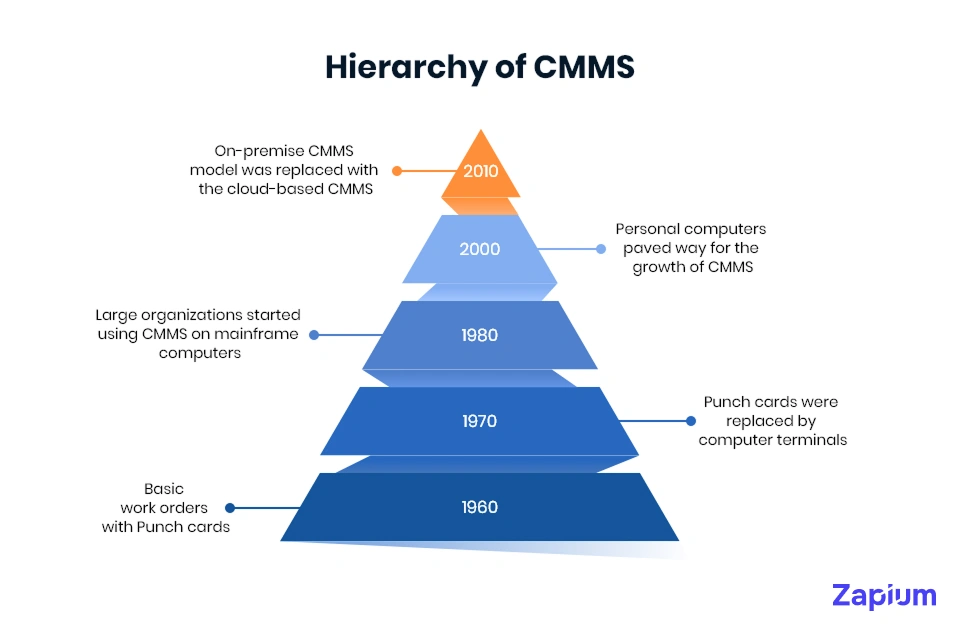
Spreadsheet replacement and centralized records: CMMS adoption increasingly replaced manual or fragmented tracking with a single system containing assets, work orders, preventive schedules, and inventory. [1] [8]
Enterprise standardization: Later implementations extended CMMS across multiple plants or sites, using standardized workflows, shared reporting, and common inventory visibility. [5] [9]
Connected and predictive maintenance: Current platforms combine CMMS workflows with IoT monitoring, AI-assisted work-order automation, and condition-based interventions, moving beyond simple recordkeeping. [3] [10] [11]
Best Real-World Examples
Fiix — specialist CMMS software representing the shift toward cloud-based maintenance management.
MaintainX — mobile-first maintenance software centered on work orders, procedures, and frontline execution.
UpKeep — mobile CMMS oriented toward maintenance teams managing work requests, assets, and preventive tasks.
Limble — cloud CMMS emphasizing preventive maintenance, asset history, and technician workflows.
eMaint — CMMS platform covering work orders, asset health, inventory, and key performance reporting. [2]
Oxmaint — specialist platform whose published examples describe CMMS standardization across manufacturing, power, facilities, fleet, and regulated sites. [5] [8] [4] [9] [7]
iFactory — example of a newer CMMS approach combining maintenance workflows with AI, computer vision, and IoT monitoring. [3] [10] [11]
Case Studies
A power-plant migration from Excel to Oxmaint illustrates the basic organizational value of a CMMS. The published case reports that, within six months, preventive-maintenance compliance rose from 61% to 94%, unplanned downtime fell by 41%, and technicians stopped spending approximately three hours each morning updating spreadsheets. [8] The example shows that implementation value can come not only from automation, but also from replacing dispersed records with scheduled, auditable workflows.
A multi-site pharmaceutical deployment demonstrates the enterprise and compliance dimension. Oxmaint reports that standardizing CMMS processes across eight plants produced 98% global preventive-maintenance compliance, reduced cross-site deviations by 41%, and enabled a consolidated audit-export package to be produced within two hours. [5] The case shows how a CMMS can function as a governance layer: it harmonizes maintenance content, enforces completion controls, and makes evidence available across locations.
A manufacturing deployment combining an AI-driven CMMS with AI-vision cameras reported a 41% reduction in unplanned downtime, an increase in overall equipment effectiveness from 67.4% to 84.1%, and a reduction in mean time to repair from 6.8 hours to 2.9 hours within nine months. [3] Because these figures come from a vendor-published case study rather than an independently controlled evaluation, they should be treated as reported outcomes, not universal expectations. [3] The example nevertheless captures the current direction of CMMS: work-order management is being connected to condition data and automated detection rather than operating only as a retrospective maintenance log.
Sources
Sources
- [1]What Is a CMMS? Definition & Guidefreemaint.com
- [2]
- [3]Manufacturing Plant Reduces Downtime with CMMSifactoryapp.com
- [4]
- [5]
- [6]Case Study: Hospital Improves Compliance with CMMS ...ifactoryapp.com
- [7]
- [8]
- [9]
- [10]
- [11]