
Defining and Describing Work Order Automations
https://www.fieldpulse.com/features/work-order-management
https://parseur.com/use-case/automate-work-orders
Defining and Describing Work Order Automations
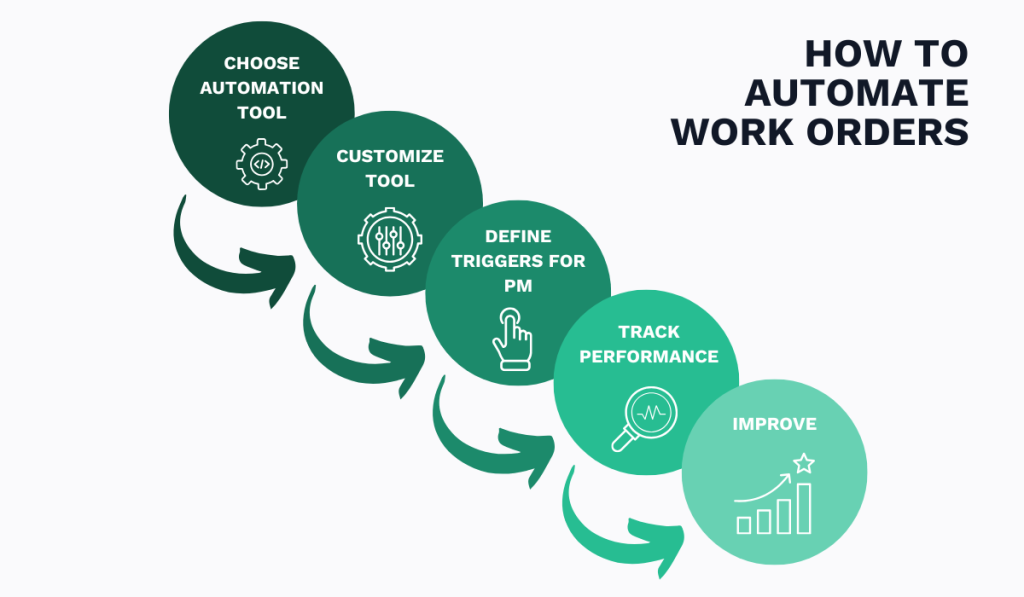
Work order automation turns maintenance requests into coordinated actions before administrative bottlenecks can slow them down.
Work order automation is the use of rules, triggers, integrations, and machine learning to create, prioritize, assign, track, and close maintenance or service jobs inside a computerized maintenance management system (CMMS) or enterprise asset-management system (EAM). [1] It applies when organizations manage recurring preventive maintenance, condition-based alerts, field-service requests, repairs, inspections, or distributed assets. [2] [1] The concept matters because automation can connect equipment data, business rules, technician capacity, parts information, and operational reporting into one workflow rather than treating work-order creation as an isolated clerical task. [2] [3]
flowchart LR
A["Asset signal or service request"] --> B["Create work order"]
B --> C["Prioritize and enrich"]
C --> D["Assign technician"]
D --> E["Execute and document"]
E --> F["Verify and close"]
F --> G["Analyze outcomes"]
G --> C
Uses in Context
In maintenance operations, the term describes automatically generating work orders from IoT sensor anomalies, condition thresholds, or equipment-health patterns rather than waiting for a planner or technician to enter a request manually. [2] [4]
In CMMS and EAM discussions, it commonly includes the complete workflow: “create, assign, track and close” maintenance jobs. [1]
In field service, it refers to automating scheduling, dispatch, skill matching, asset management, and billing around service work orders. [5]
In ERP environments, it can mean parsing incoming orders, applying structured business rules, allocating work, and routing exceptions for human approval. [6]
In facilities management, automation is also used to collect and organize work-order data so teams spend less time manually preparing operational updates. [7]
History of Use
Origins
Work orders predate software: paper-based work-order systems existed for decades in workshops, plant rooms, and fleet depots. [8]
The digital lineage moved from paper forms to spreadsheets and then to dedicated CMMS platforms. Paper systems made records difficult to retrieve and report on, while spreadsheet systems improved searchability but still required substantial manual status updates. [9]
The modern phrase work order automation is best understood as an industry practice label rather than a clearly attributable academic invention. Available sources describe its components—digital work orders, scheduled maintenance, sensor-triggered alerts, rules-based routing, and automated reporting—but do not identify a single inventor or definitive first publication. [2] [1] [3] [9]
Evolution
Paper era: Organizations manually created, filed, assigned, and tracked work orders, creating risks of lost records, illegible handwriting, and fragmented maintenance histories. [9]
CMMS and ERP era: Dedicated maintenance systems centralized work-order records and introduced scheduled maintenance, structured workflows, reporting, and basic automation. [9]
Connected and AI-assisted era: IoT sensors, computer vision, APIs, machine learning, and Predictive-Maintenance Models expanded automation from recordkeeping into automatic detection, prioritization, recommended actions, and parts planning. [2] [4] [1]
Best Real-World Examples
OXMaint AI work-order management — uses sensor anomalies, condition thresholds, and pattern matching to generate prioritized work orders with failure probabilities, recommended actions, and required parts. [4]
Podtech AI-first work-order automation — frames automation as rules, triggers, and machine learning operating across the full CMMS work-order lifecycle. [1]
Leaner Studio automated ERP allocation — combines n8n, FastAPI, Slack, JSON schemas, and human-in-the-loop validation to allocate ERP work orders. [6]
SystemTask field-service ERP — combines automated scheduling, dispatch boards, skill matching, asset management, partner portals, and billing for distributed service locations. [5]
ServiceChannel and EG On The Move — demonstrates automated collection and organization of work-order data for facilities reporting. [7]
SAP logistics work-order automation — illustrates an integrated model using IoT sensors, a CMMS mobile application, APIs, and time- or counter-based maintenance plans. [2]
Case Studies
A logistics operator running three distribution centers reportedly managed 480 maintenance assets and an average of 85 work orders per day with four planners. Over a 12-week deployment, the operator connected IoT sensors to 120 critical assets, equipped 28 technicians with a CMMS mobile application, integrated SAP APIs for automated work-order creation, and activated 340 time- and counter-based maintenance plans. [2] After 90 days, the source reported that 78% of work orders were generated automatically, detection-to-action time fell from 14 hours to 23 minutes, preventive-maintenance compliance increased from 71% to 97%, and the backlog declined from 260 to 45 open orders. [2] The example shows that automation is not merely a form-filling feature: its operational value comes from linking detection, creation, mobile execution, and preventive-maintenance planning. [2]
A specialty-chemical manufacturer described in an OXMaint case study operated three production facilities, 2,800 tracked assets, and a 340-order overdue backlog. [4] Its AI-assisted system reportedly used sensor anomalies, condition thresholds, and pattern matches to create prioritized work orders containing failure probability, recommended action, and required parts; the case study attributes a 41% reduction in mean time to repair and $1.6 million in annual maintenance savings to the deployment. [4] Because these figures come from a vendor-published case study, they should be treated as reported implementation outcomes rather than independently verified industry benchmarks. [4]
A manufacturing organization called MidTown Manufacturing reportedly struggled with manual work-order allocation inside its ERP system, where staff entered and assigned orders by hand, causing delays, misallocations, and higher costs from human error. [6] Leaner Studio built a workflow using n8n, Fast API, Slack, custom APIs, structured JSON schemas, and human validation with manual overrides. [6] The reported result was an 85% faster allocation process. [6] This case illustrates an important design principle: effective automation can preserve human judgment at exception points instead of attempting to eliminate human involvement from every decision. [6]
Sources
Sources
- [1]
- [2]SAP Work Order Automation For Logisticsoxmaint.com
- [3]
- [4]
- [5]Case Studies | AI, ERP & Software Projects by Infomazeinfomazeelite.com
- [6]Automated Work Order Allocation Systemleanerstudio.com
- [7]Case Study: EG On The Moveservicechannel.com
- [8]
- [9]Work Order Management Guide: Software, Process & Best Practicespreventivehq.com